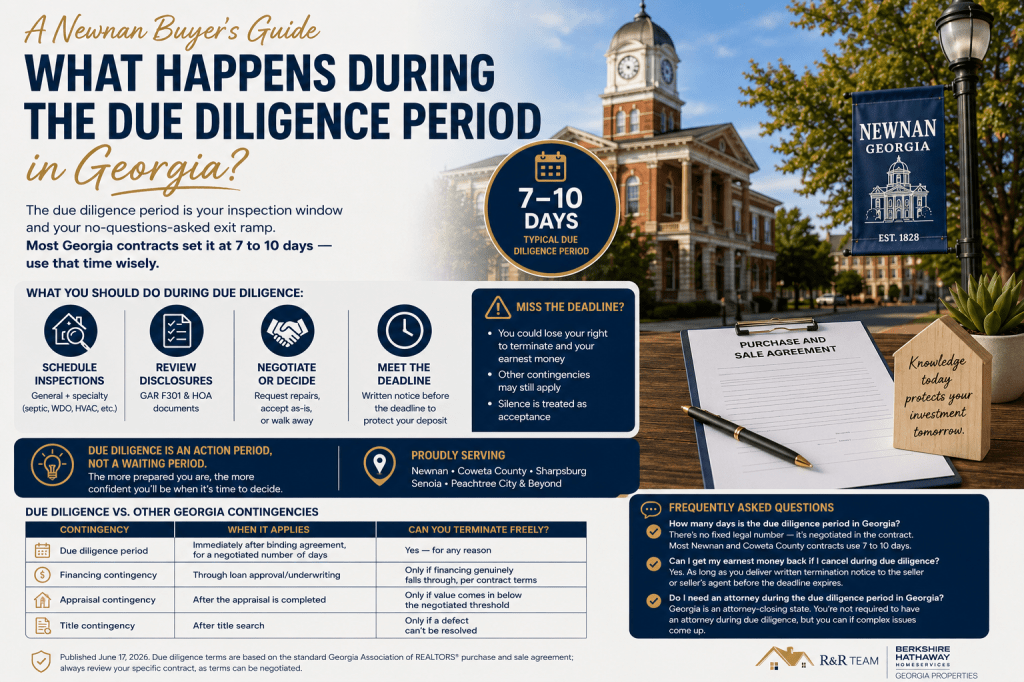
What happens during the due diligence period in Georgia? The due diligence period is the window after you go under contract when you can inspect a Newnan, GA home, negotiate repairs, and walk away for any reason without losing your earnest money. Most Georgia contracts set it at 7 to 10 days, and missing the deadline can cost you that deposit.
If you’ve ever stared at a Georgia purchase and sale agreement wondering what that “due diligence” clause actually means for you, you’re not alone. I get this question from almost every buyer I work with across Newnan and Coweta County, usually within a day or two of going under contract — right when the clock starts ticking. As a REALTOR® with the R&R Team at Berkshire Hathaway HomeServices Georgia Properties, I’ve walked dozens of buyers through this exact period, and it’s the part of the process where a little knowledge prevents a lot of stress.
Georgia handles this differently than many states. There’s no separate “attorney review period” here — due diligence does double duty as your inspection window and your no-questions-asked exit ramp. Understanding how it works, and what deadlines actually matter, is one of the most important things you can do before you ever make an offer in Coweta County.
What Is the Due Diligence Period, Exactly?
The due diligence period is a negotiated span of time, written directly into the Georgia Association of REALTORS® (GAR) purchase and sale agreement, during which the buyer has the right to terminate the contract for any reason — or no reason at all — and receive their earnest money back in full.
This is the single broadest protection a buyer has in a Georgia transaction. During due diligence, you don’t need to justify your decision to walk away. After it ends, that flexibility disappears, and you typically need a specific contractual contingency (financing, appraisal, etc.) to terminate without forfeiting your deposit.
Georgia law doesn’t dictate a set number of days — the length is negotiated between buyer and seller and written into the contract. In my experience writing offers across Newnan, Sharpsburg, Senoia, and Peachtree City, 7 to 10 days is typical, though I’ve seen anywhere from 3 to 14 days depending on how competitive the listing is and how quickly the buyer’s inspector can get in.
What Should You Actually Do During Due Diligence?
This period exists so you can do your homework before you’re financially locked in. Here’s what that homework should include:
- Schedule your home inspection immediately. Don’t wait until day 5 of a 7-day period — book your inspector the same day you go under contract.
- Order any specialty inspections your general inspector recommends (septic, well, termite/WDO, foundation, HVAC).
- Review the seller’s property disclosure (GAR F301) line by line and ask your agent about anything unclear.
- Pull HOA documents and covenants if the property is in a subdivision with an association.
- Confirm your lender is moving on the appraisal and underwriting so financing timelines align with closing.
- Walk the property again with fresh eyes, ideally at a different time of day than your first visit.
- Decide, in writing, before the deadline — proceed, negotiate, or terminate.
The single most important takeaway: due diligence is an action period, not a waiting period. Buyers who treat it passively are the ones who end up scrambling on the last day.
How Does Repair Negotiation Work?
If your inspection turns up issues, you have three paths during due diligence:
- Request repairs or a credit from the seller via a formal amendment.
- Accept the property as-is and proceed to closing.
- Terminate the contract and get your earnest money back, no negotiation required.
Sellers are not obligated to agree to repair requests. If negotiations stall, your leverage is the calendar — once the deadline passes without a signed amendment or termination notice, you’ve effectively accepted the property in its current condition (unless another contingency still applies).
What Happens If You Miss the Due Diligence Deadline?
This is where I see buyers get hurt, and it’s almost always a paperwork problem, not a decision problem. Termination during due diligence must be in writing and delivered to the seller or seller’s agent before the deadline expires — not just decided on internally.
Missing that window, even by hours, can mean:
- You lose the unrestricted right to terminate and keep your earnest money.
- You may still have other contingencies (financing, appraisal) available, but those are narrower and require specific justification.
- The seller could treat your silence as acceptance and expect you to proceed to closing.
If you’re getting close to a deadline and still deciding, talk to your agent before the day arrives — not on it.
How Does This Affect Sellers in Coweta County?
If you’re selling in Newnan or Coweta County, due diligence cuts both ways. Once you accept an offer, your home is effectively off the market while the buyer evaluates it — but you can still negotiate the repair amendment instead of automatically agreeing to every request. According to Redfin’s county-level data, homes in Coweta County have recently taken longer to sell than they did a year ago, with inventory rising. In a market like that, sellers benefit from a clean, well-documented disclosure (GAR F301) going in, since it reduces the odds of a buyer finding a surprise during their inspection that derails the deal.
Due Diligence vs. Other Georgia Contingencies
| Contingency | When It Applies | Can You Terminate Freely? |
|---|---|---|
| Due diligence period | Immediately after binding agreement, for a negotiated number of days | Yes — for any reason |
| Financing contingency | Through loan approval/underwriting | Only if financing genuinely falls through, per contract terms |
| Appraisal contingency | After the appraisal is completed | Only if value comes in below the negotiated threshold |
| Title contingency | After title search | Only if a defect can’t be resolved |
Frequently Asked Questions
How many days is the due diligence period in Georgia?
There’s no fixed legal number — it’s negotiated in the contract. Most Newnan and Coweta County contracts use 7 to 10 days, though shorter or longer periods are common depending on the property and market conditions.
Can I get my earnest money back if I cancel during due diligence?
Yes. As long as you deliver written termination notice to the seller or seller’s agent before the due diligence deadline expires, you’re entitled to a full refund of your earnest money under the standard GAR contract.
Do I need an attorney during the due diligence period in Georgia?
Georgia is an attorney-closing state, meaning a real estate attorney handles your closing regardless. Many buyers also consult an attorney during due diligence if complex issues — like easements or title questions — come up, though it’s not required to exercise your termination rights.
What’s the average price per square foot in Coweta County right now?
Pricing varies meaningfully by subdivision and home age, so rather than quote a single county-wide number that can mislead, I pull current comparable sales for your specific area when we talk — that’s the only way to get an answer you can actually rely on.
Ready to Talk Through Your Contract?
Going under contract in Coweta County and want a second set of eyes on your due diligence timeline? Schedule a free consultation with Mark Robertson — call or text 678-783-0715, or reach out anytime at marcus46521@gmail.com.
Published June 17, 2026. Due diligence terms are based on the standard Georgia Association of REALTORS® purchase and sale agreement; always review your specific contract, as terms can be negotiated.
Sources: Georgia Association of REALTORS®, National Association of REALTORS®, Consumer Financial Protection Bureau, Redfin Coweta County Housing Market
 Jacqui Robertson - Newnan Realtor - Berkshire Hathaway Home Services
Leave a comment